


When carbonized oak tree leaves and pieces of bark were falling from the sky, Dave Van Bossuyt knew it was time to leave his forest home near Dinkey Creek.
The retired forester had been tracking the Garnet Fire since it started about 15 miles away in the Sierra National Forest east of Fresno. But after the lightning-caused fire crossed Dinkey Creek Canyon and began moving toward his community, the threat felt much closer.
“We knew it was going to come this way,” Van Bossuyt said. “The fire was so intense.”
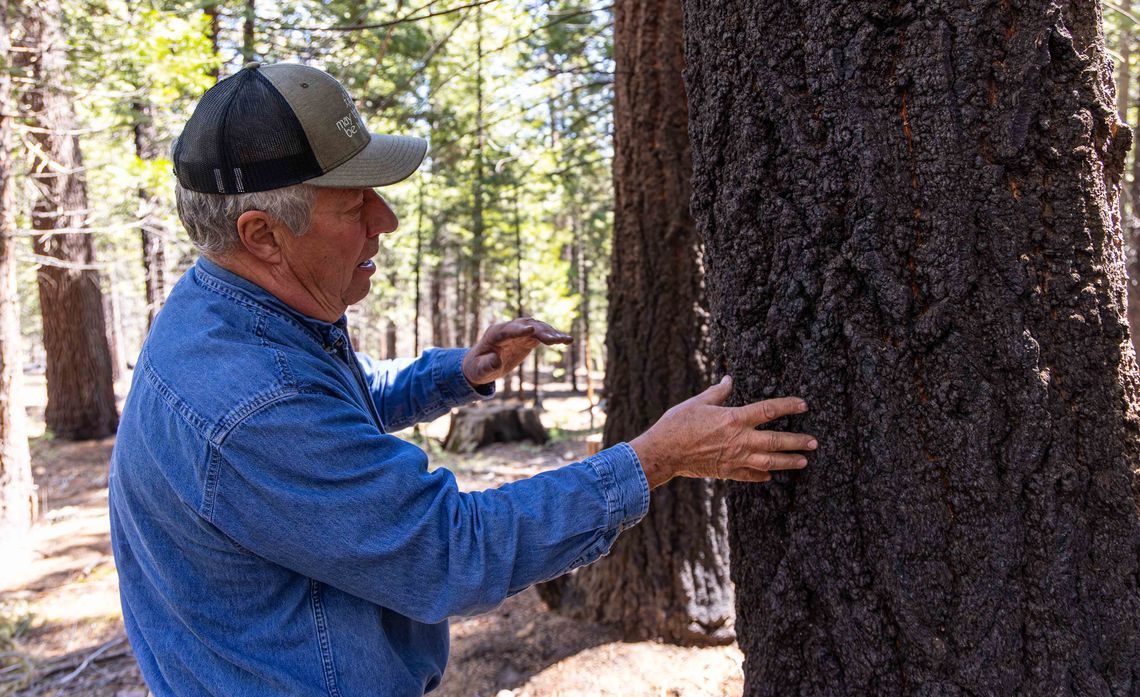
Dave Van Bossuyt has spent 14 years thinning trees, removing dead vegetation and completing prescribed burns to reduce wildfire risk on his 61-acre property near Dinkey Creek.
When evacuation orders came, Van Bossuyt and his wife took their fifth-wheel trailer to Camp Edison, where they spent 13 days wondering whether their home would survive.
Van Bossuyt had reason to hope. He had spent the last 14 years trying to reduce the risk of wildfire on his 61-acre wooded property — thinning trees, removing dead vegetation and doing prescribed burns. Beyond his property stood an even larger-scale defense: a roughly 12-mile-long, 400-foot-wide shaded fuel break, built by the Southern California Edison Forestry Team on SCE-owned forestland.
SCE, in partnership with the Highway 168 Fire Safe Council, had nearly completed the Lost Bluff Fuel Break when the fire erupted in August 2025.
“Knowing that fires from these areas are inevitable, our team was able to identify and position the fuel break where it would hopefully provide the greatest benefit,” said Jeffry Pierini, SCE senior supervisor of Vegetation Management and Forestry.

To create a shaded fuel break, crews kept mature trees while removing brush, dead wood and smaller trees. That set up gave firefighters a safer place to move equipment, build containment lines and burn vegetation ahead of the wildfire before it could feed the flames.
“Without that fuel break, crews would have had to fall back to a road or another barrier, delaying firefighting efforts and giving the fire more room to grow,” said Pierini.
When the Garnet Fire reached the treated land, crews saw its behavior change. In several places, flames dropped from the treetops to the forest floor and burned with less intensity. CAL FIRE found that some treated areas experienced less than 5% tree mortality, similar to a prescribed burn.
While the Garnet Fire eventually ripped through 59,844 acres, it did not reach Dinkey Creek.
The Lost Bluff Fuel Break also protected the forest’s habitat for species such as the Pacific fisher and spotted owl. For Pierini, who has worked on SCE’s forestland for 15 years, that impact is personal.

“It’s essentially a second home for me,” he said. “I have a relationship with the land, with the trees, with the forest, with the wildlife. That is the case with many others who live in the surrounding Sierra communities.”
SCE’s Forestry Team is applying lessons learned to keep strengthening forest resilience. Each year, the team treats around 2,000 acres of forest through fuel break construction, maintenance and other efforts that help reduce wildfire risk and improve forest health. At the same time, SCE Forestry is still restoring areas affected by the Garnet Fire.
This fall, the team will remove trees decimated by the fire from heavily burned areas. After the first rainfall, they will reforest with about 50,000 conifer seedlings grown from locally collected seeds. The team will also continue prescribed burns to reduce wildfire fuel and support healthier plants and wildlife.
Back home nearly a year later, Van Bossuyt can see what years of preparation has helped protect.
“If SCE hadn’t done all that pre-work on their land, that fire would have been right here,” he said. “It would have been right here.”
For more information on SCE’s wildfire mitigation efforts, visit sce.com/wildfiresafety.


